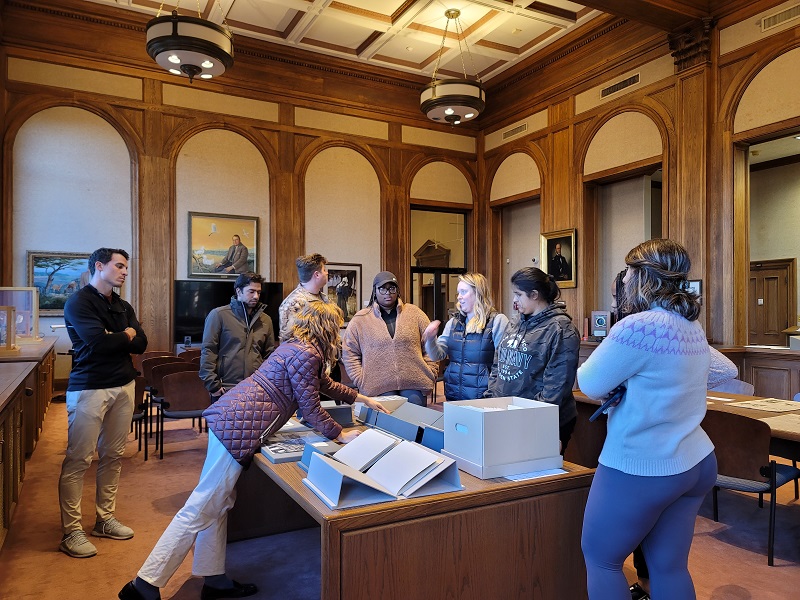
I teach a range of courses both “critical” and “creative — not only in their larger description and design, but also in their more granular engagements across the semester. Within period, genre, and topics courses, I offer opportunities for group and individual projects that encourage creative engagement and production. And in courses oriented toward forms of creative writing or production, our work is of course situated within a discourse populated by makers who have preceded us. In both contexts, I try to create reading lists that reflect the diversity of historical and contemporary practices, and whenever possible and appropriate to our topics and contexts, I include recent and contemporary practitioners whose interviews, performances, or visual portfolios may be easily found on the open Web. In both critical and creative courses, I offer several prompts for student writing, so that students may choose their mode of response and how they engage with the course material. When I supervise theses or independent studies, it is my practice to structure the reading lists and learning goals in dialogue with my students because I believe that writing the proposal, the list, and the proposed outcomes are in fact part of this work for higher-level students in advanced stages of study. These lists and outcomes, as I reiterate over the course of such projects, are open to revision as the projects develop per the student’s interest.
Recent Courses
ENG 203 : Intro to poetry Writing
This is an introductory workshop in poetry writing. It’s designed to both explore and challenge various notions of what poems can be, and how they are written. The course is workshop-based, and follows a schedule of frequent workshops punctuated by readings in a variety of poetic forms and practices. The course is divided into four units (each about three or four weeks long). We’ll begin with a unit on the “Ars Poetica” (poems on the theme of poetry); then we’ll move into a unit on “Forms” (both verse and genre forms). After “Forms,” we’ll move to “Rules and Procedures” (on generative practices and restrictions), and we’ll conclude the course with a unit on “Materials” (exploring the aural, textural, bibliographical, and scriptural “stuff” of poetry). In each case, and throughout the course, we’ll hew closely to the etymological origins of the word “poetry,” deriving as it does from a Greek word, “poiesis,” meaning “to make.”
ENG 245: Book History / Arts / Culture
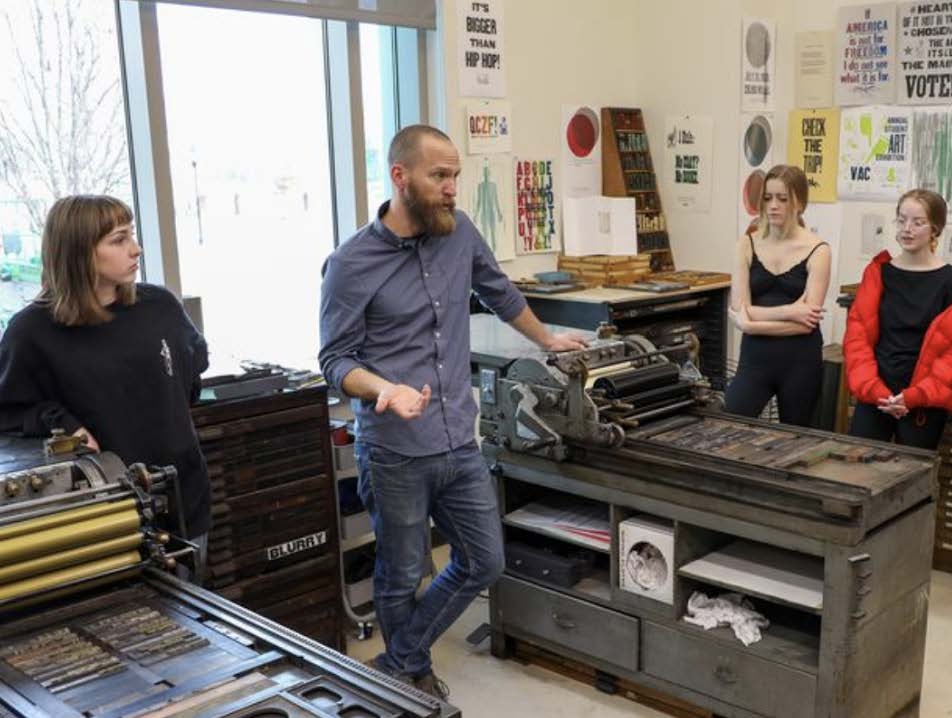
This is a course exploring the history, practice, and potentials of “the book.” Readings and other materials will be historical, literary, and theoretical, and will consider the changing status of the book with a focus from the late 19th century to the present. Activities are both critical and creative, and will include several short writing assignments and hands-on student projects, leading toward a group portfolio of critically-situated creative works (cards, broadsides, posters, and pamphlets or artists’ books).
ENG 380: Archives and Afterlives in American lit.
“The past,” Emily Dickinson cautions, “is such a curious creature.” This course examines how that curious creature, particularly Dickinson’s own nineteenth century, persists into the present. We’ll take up this question by reading primary literary and social texts from the era, including poetry, fiction, essays and lectures, and contemporaneous news media, and examining how these have more recently been adapted, extended, and/or appropriated not only in literary texts but also other popular genres in the twentieth- and twenty-first centuries. In the course of our work, we’ll consider how these latter engagements with such seemingly distant texts and contexts inform us about our own situation as twenty-first century readers. Readings include nineteenth-century popular and literary periodicals in archival and digital settings, as well as Emily Dickinson, Frederick Douglass, W.E.B. Du Bois, Ralph Waldo Emerson, Rob Halpern, Susan Howe, Harriet Jacobs, Tyehimba Jess, DJ Spooky that Subliminal Kid, Colson Whitehead, Walt Whitman, and others, and contemporary media (e.g. Levi’s ad campaigns, selections from Comedy Central’s Drunk History, and the Apple TV+ series Dickinson). Projects and assignments include periodic response papers, group presentations, a midterm essay, and a final research-driven creative engagement with a work or works of the course.
ENG 309: Document Dictation, Ritual
The word “poetry” comes from a Greek root, poiesis, which is related to a form of the verb “to make.” Let’s therefore remind ourselves, here and now, that a poem is a made thing, and that to talk about poetics is to talk about acts and/or habits of making. We may find it useful to begin with this reminder, because so much of the contemporary imagination regarding “writing” centers on imagination, individuality, and solitude. What happens when we break open these ideas, and focus on the act of writing as an act of making? What happens when we give ourselves over to process, and let the poem and the process underhand lead the way? While there may be any number of ways to do so, this course is organized around three (hopefully) generative approaches to the writing of poems: Dictation, Document, and Ritual. What does it mean to receiverather than to write one’s poems? How does conceiving of the poem, the page, and even the word as an object already in the world change what it means to make a poem? And what about repeated and/or structured habits of presence or presentation—which we might call ritual? We will explore a small set of writers who are exemplary in these regards, and we will read and discuss their works, engage with these modes of making, and share and discuss our works with each other. Our course will be divided into three units on the previous topics, and each unit will include one sustained workshop session. You will keep a notebook, write a series of exercises, and respond in a sustained manner to our primary readings, and you will share your work in a structured manner in smaller groups. You will also be workshopped by the full class once during the semester. At the end of the semester, you will have a portfolio of these pieces, along with other short-form prose responses. Our goal, over the course of the semester, is not to write a perfect workshop poem, but rather to develop and sustain a series of generative writing practices.
WRI 101: Bad Art
This writing course examines “bad art”: cultural productions that raise questions about censorship and freedom of expression, the ethics of representation, “camp” and “bad” taste, and good art made by bad people. We will consider a variety of cultural forms, including literary texts (poems, fiction); music, television and film; and the visual arts. We will work to develop criteria for engaging with these forms; to develop these criteria, we will read critical theory, popular journalism, and literary and art criticism. Student writing will include shorter, low-stakes assignments, informal presentations, and a series of essays (three) executed through a sequence of individual and group-oriented activities (e.g. conferences, peer-review, drafting and revision).
